According to McKinsey, 88% of companies now use AI in at least one business function. BCG, reports that only 5% see meaningful financial returns, and roughly 60% see no material return on their investment at all.
There is a specific cause for the gap between adoption and results: the technology is the easy part. The hard part is putting the organizational conditions in place that determine whether it pays off. McKinsey’s 2025 research found that companies generating significant AI returns were nearly three times more likely to have fundamentally redesigned their workflows around AI rather than layering it into existing processes. And that workflow redesign is a people decision that requires employees to trust that the organization is investing in them rather than automating them out — a belief earned by leaders not installed through platforms.
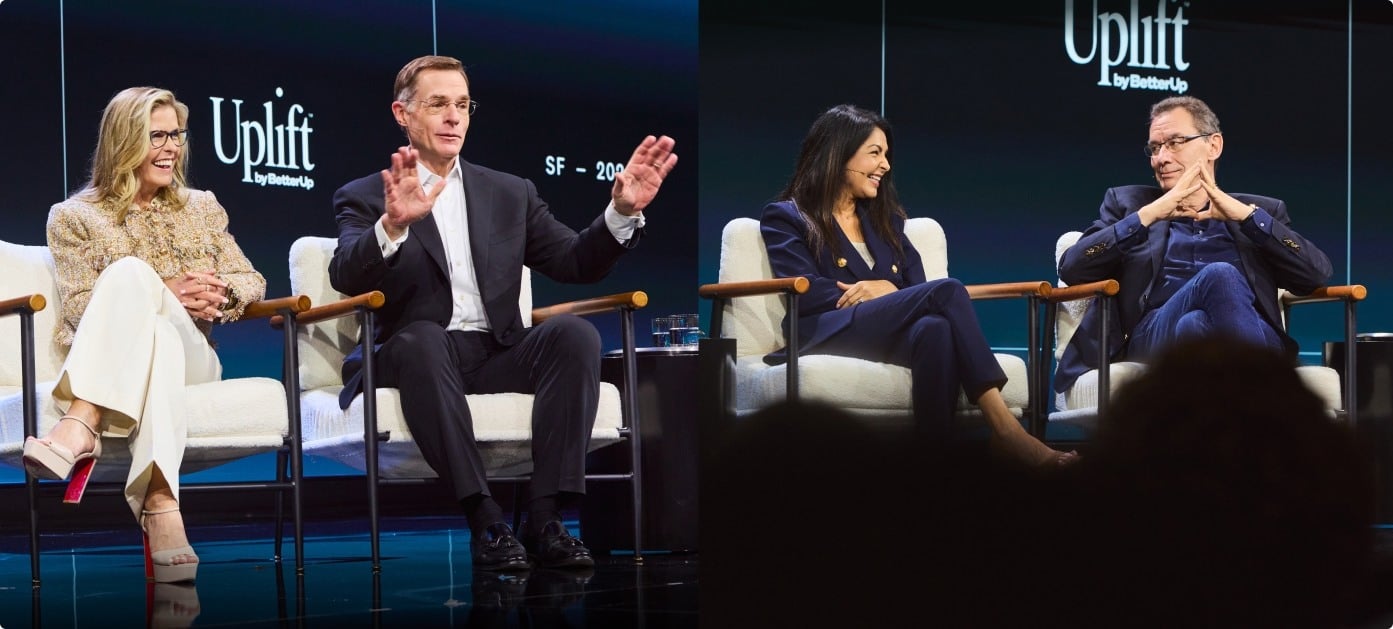
At BetterUp's annual Uplift conference in San Francisco, two CEO–chief people executive partnerships made that case with data. Aon's President & CEO Greg Case and Chief Administrative Officer Lisa Stevens brought two decades of evidence from turning a 60,000-person firm into what Case calls a global focus group on workforce strategy. Pfizer's Chairman and CEO Dr. Albert Bourla and Chief People Experience Officer & EVP Payal Sahni brought a lived example of an AI transformation across a company that navigated a pandemic and a series of major acquisitions. Both built the AI strategy around the people strategy, not the other way around.
Why people strategy, not technology, should lead your AI transformation
Before Pfizer rolled out AI across its global workforce, Bourla and Sahni had a decision to make: bring in centralized AI leadership with a top-down mandate, or hand accountability to leaders already inside the organization and let them drive it.
Bourla's reasoning: "The bottleneck is not the technology. It is how you use AI within your own organization to transform it." A centralized AI function can procure the platform and run the pilot. It can’t redesign how thousands of people do their jobs. Only the people who already own those jobs can do that.
So Pfizer built the rollout around them. They connected the potential of AI to Pfizer’s purpose – using AI to work faster will help to bring breakthroughs to patients who don’t have time. They also embedded the tools directly into systems people already used, like the performance management process and the goal-setting cycle. When colleagues asked whether AI would affect their roles, Sahni told them directly: yes, roles would change, and Pfizer would commit to skill everyone up.
Not every AI rollout gets that positive response. Most companies treat AI as a technology procurement decision: select the platform, run the pilot, push adoption. People comply on the surface and work around it underneath. Leadership reads this as change fatigue or resistance to technology, but AI makes the stakes personal in a way that a new CRM doesn’t. When the new tool can perform tasks on some job description, an employee may worry they will become unnecessary. That worry doesn't go away when leadership decides not to address it. It moves underground, where it becomes harder to manage. BetterUp Labs research bears this out: employees who trust their leaders are 46% more likely to believe AI is augmenting their skills rather than replacing them.
Pfizer’s approach works because employees who understand why a change is happening and trust that the organization is invested in their success behave differently. They surface problems early, experiment with the tool, and help teammates figure it out. None of that appears in your AI budget line, but together it determines whether your investment pays off.
The takeaway: If your CEO still treats the people agenda as downstream of the AI strategy, the rollout is already behind before the tool ships.
How Aon built a people-led AI transformation model
Aon has been treating workforce strategy as capital strategy longer than most companies have been thinking about AI. On stage at Uplift, Greg Case described four megatrends — Trade, Technology, Weather, and Workforce — driving market volatility and reshaping how the world’s largest companies operate. What most leadership teams miss is the ways in which they interconnect.
He used weather as an example. Imagine that changes in climate lead to higher temperatures and a company realizes that 120°F is too hot for outdoor workers. In most organizations, that's an operations problem or a safety problem. Case said, it's a human capital problem that drives capital allocation decisions. Where do you build? How do you staff? What does the shift structure look like? The workforce question and the capital question are the same question.
The same pattern applies to AI rollouts. Picking an AI tool looks like a technology decision. But to get value from it, work gets done has to be redesigned. When roles change, people need to trust that their leaders are being straight with them about what comes next. Trust gets built by the leaders communicating the change, not by the tool or the rollout plan. Case put it simply: “The winners in the application of AI will lead with a world-class people strategy. AI isn’t our strategy — it is an enabler of our strategy.” That distinction has structural consequences. The CEO and chief people executive are the only two leaders whose combined authority covers the whole chain, from tool selection to the manager conversations that determine whether employees trust what’s coming.
The takeaway: Most capital decisions your company makes in the next 24 months will be workforce decisions in disguise.
Three moves for the people executive making the case for AI investment
- Replace reassurance with a commitment.
Most AI communications today lead with reassurance and stop before making any commitment about what the organization will actually do. In your next AI communication, name specifically which roles will look different and what the organization is committing to do about it. - Get upstream of how decisions get framed.
Once a decision is framed as a technology procurement, the people dimensions get added as implementation considerations — the core decisions have already been made. Get into those conversations before the agenda is set. If your CEO is making AI investment decisions without the people executive in the room, that is the problem to solve first. Everything else is downstream of it. - Once you’re in the room, negotiate for authority, not access.
People executives get consulted on change management after the technology decisions are made and asked to explain engagement scores after the damage is done. That structure produces the exact results the data have shown to date: adoption without impact. Negotiate for authority over the decisions that determine AI outcomes – role redesign, manager accountability, what gets measured, and how AI communications are framed. The conditions the people function control are the variables determining whether the AI investment pays off.
The bottom line
The organizations that figure out people-led AI transformation early will have a compounding advantage. The ones that don't will spend the next several years explaining why their AI adoption numbers look strong and their business results don’t.
Your CEO and chief people executive either own this together or neither of them owns it. There is no middle path that produces results.
—
Want to know where your organization stands? BetterUp Labs has identified five communication dimensions that predict whether healthy AI norms take hold. Use the framework to rate your organization. Download now.