Boards want ROI from AI investments. Yesterday, if possible. That pressure is pushing organizations toward a familiar playbook: automate, reduce headcount, cut costs.
But what if that's the wrong bet?
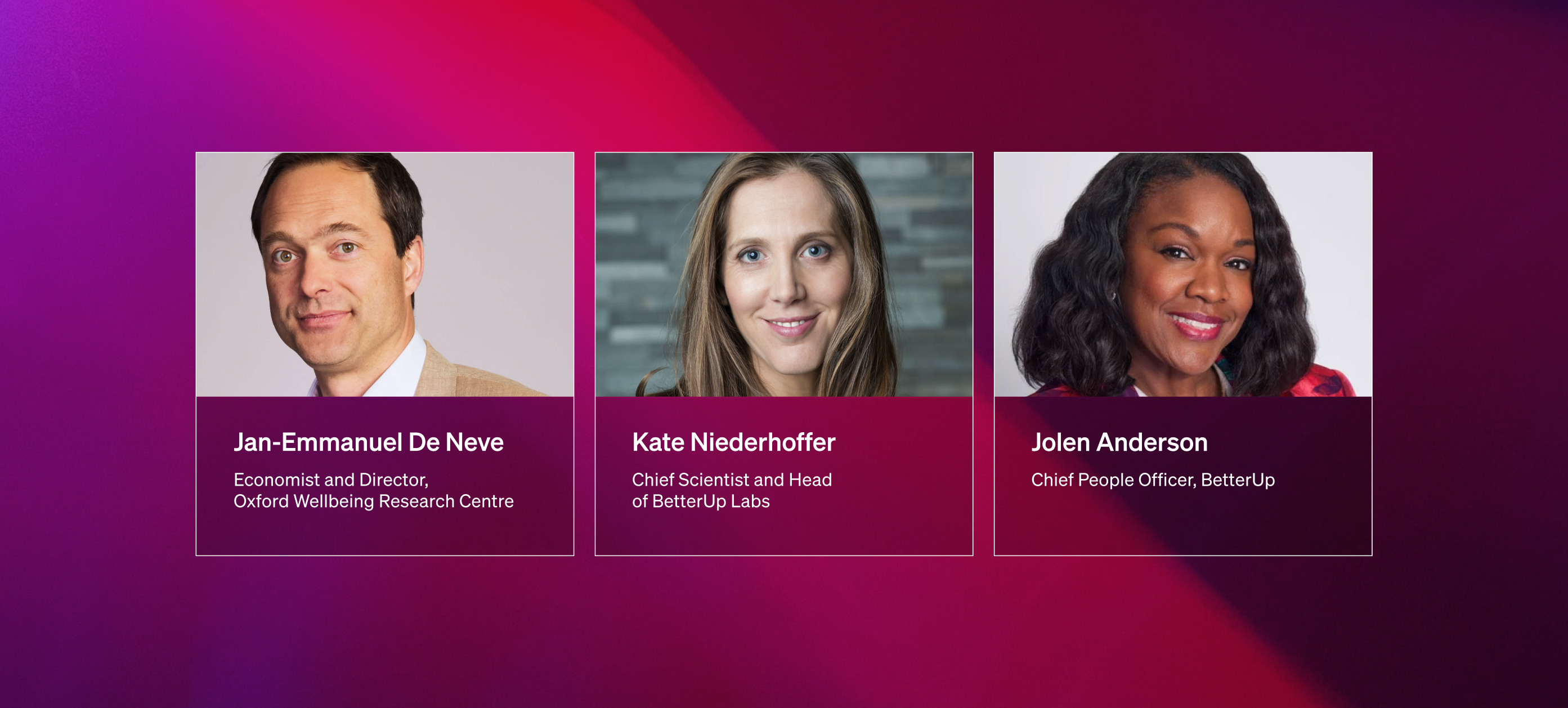
In a recent conversation, Jan-Emmanuel De Neve, Professor of Economics and Behavioural Science at Oxford and coauthor of Why Workplace Well-Being Matters, joined BetterUp’s Chief Scientist Kate Niederhoffer to unpack findings from forthcoming research conducted with Jeff Hancock, Director of the Stanford Social Media Lab, on how AI is being adopted inside organizations.
Their argument is counterintuitive and, for many leaders, inconvenient: the companies winning with AI won’t be the ones automating fastest. They’ll be the ones that pair AI investment with human investment.
The productivity J-curve no one talks about
De Neve points to research from his Stanford colleague Erik Brynjolfsson showing that tech investment represents roughly one-ninth of what's actually required to realize value from a general-purpose technology like AI. The rest? Rewiring organizations, upskilling people, redesigning processes. Most companies underinvest in these "intangibles" and then wonder why returns lag.
The result: premature headcount cuts based on efficiencies that haven't materialized yet. "That's really the worst of all worlds," De Neve says.
What employees are actually sensing
Niederhoffer's research tracks how workers experience AI adoption in real time. The finding that stands out: 62% of desk workers across the US, Canada, and UK believe their organization wants to augment their abilities rather than replace them.
That perception matters more than you might think. When employees sense replacement rather than investment, three behavioral dynamics kick in. Niederhoffer walks through each in detail, but the cascade affects everything from well-being to workflow quality to your future talent pipeline.
A framework for what's actually at stake
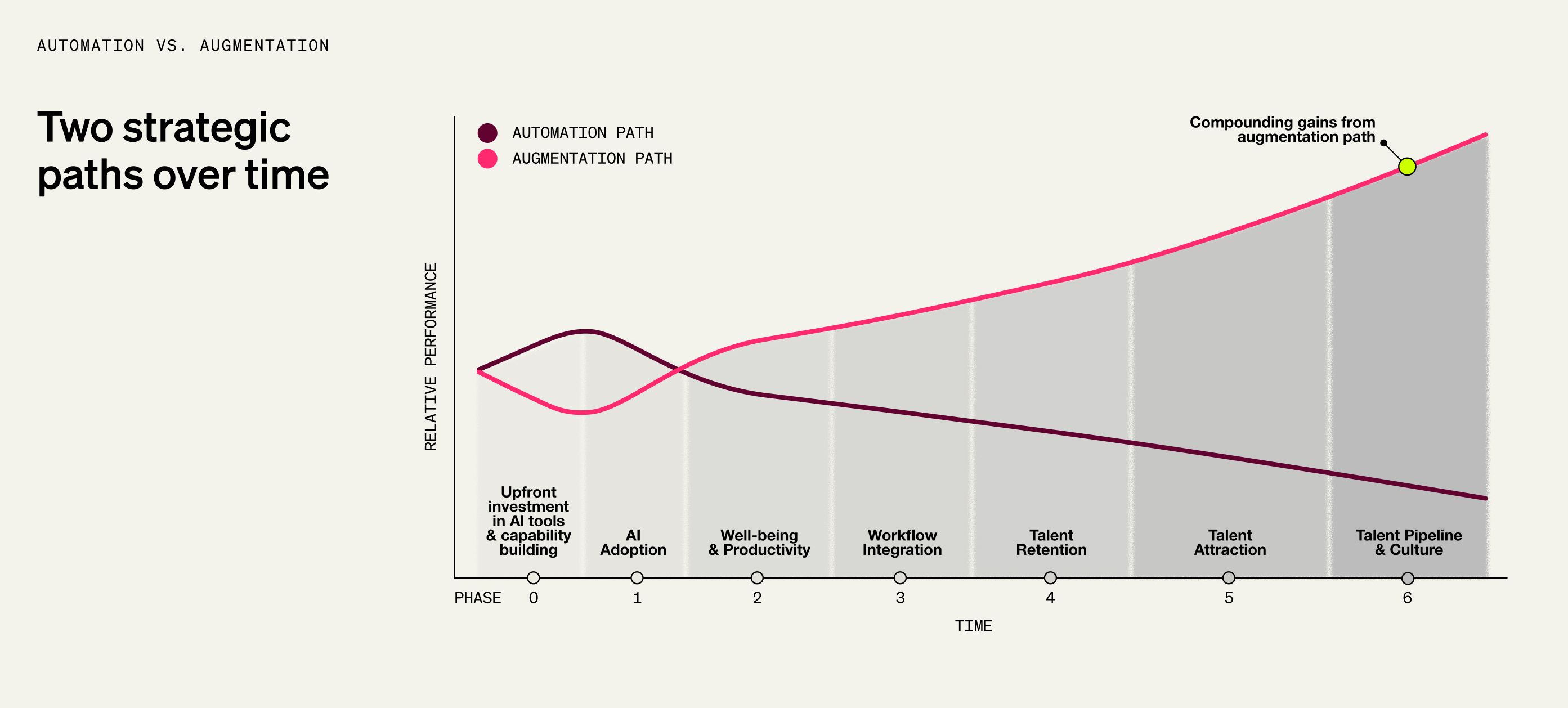
De Neve and Niederhoffer map the two paths across six phases, from initial investment through talent pipeline effects. The divergence is slow at first. Then it compounds.
What the chart can't show is why the lines diverge the way they do. That's where the behavioral dynamics come in: what happens to AI adoption when employees sense replacement, how well-being and productivity interact, and why the automation path often undercuts its own efficiency gains. De Neve walks through each phase in detail.
The workslop problem
Niederhoffer addresses a question many organizations are quietly grappling with: Is AI actually improving work quality, or are we just scaling mediocrity faster?
Her answer depends on one variable most companies overlook.
Watch the full conversation
The recording covers ground we can't fully summarize here: how to make the business case for the augmentation path, what a "credible commitment" to employees actually looks like, and why the Harvard economics department's finding on AI's "seniority bias" should worry anyone thinking about their talent pipeline.


