Most organizations have gotten good at measuring individual AI adoption. They track literacy scores and usage rates.
What they haven’t measured is what’s happening between people.
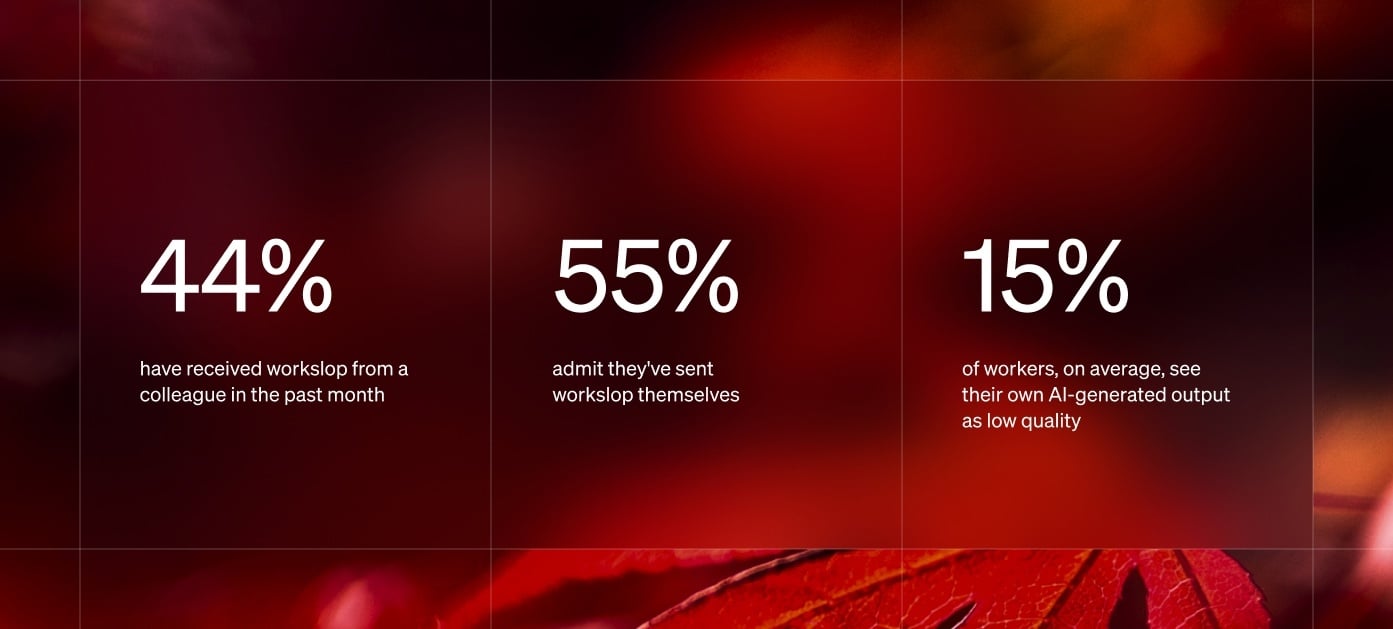
Workslop — AI-generated work that looks polished but isn’t — is one signal of what’s happening with team dynamics. An estimated 40% of employees have received workslop, with each incident requiring about two hours of additional work.
But those numbers obscure something bigger: a relational fallout among teams.
A 1,000-person study from BetterUp Labs, in partnership with the Stanford Social Media Lab, found that employees increasingly go to AI for input instead of going to their colleagues. That shift measurably lowers team effectiveness and raises retention risks. For a 10,000-person company, AI-driven displacement turnover costs approximately $27 million a year.
The organizations pulling ahead aren't the ones with the highest AI adoption scores. They're the ones building conditions that get people to invest in AI and in each other at the same time.
What AI adoption metrics are missing
Adoption dashboards measure who's using AI and how often. They don't measure who your employees are turning when they need input or support: AI or the person at the next desk. That’s the gap this research set out to close, and it's a bigger problem than workslop alone.
AI adoption's blind spot: Teammates turning to AI instead of each other
Twenty percent of desk workers report intentions to go to AI over their teammates. Forty-nine percent say their own teammates now come to them less often, because those teammates are going to AI first.
“I’m able to concentrate on my own work, but also I value creating connections with others. So it can feel a bit lonelier as people don't need to rely on each other as much anymore.” — VP of Engineering
This pattern doesn't show up in any AI adoption metric leaders currently track.
Why frequent AI users misjudge their team's expertise
Frequent AI users believe the technology is sharpening expertise and improving work quality: 71% of daily AI users rate their team as highly specialized, compared with 56% of infrequent users. What's unclear is where that expertise actually sits. The gap may reflect a false impression created by working alongside a tool that seems to know everything, rather than any real change in what teammates know.
Why AI displacement is a business problem, not just a culture problem
Employees who go to teammates instead of AI are 7.3 times more likely to report strong team coordination and 9.5 times more likely to report strong team trust than employees who go to AI over their teammates.
The link between team trust and coordination
When coordination breaks down and trust erodes, the costs show up in day-to-day operations: duplicated work, slower decisions, and avoidance. This highlights the importance of ensuring employees are not being displaced and experiencing this breakdown in coordination.
What displaced departures cost your organization
Workers who feel displaced by AI are 3.3 times less likely to want to work with their team again. They’re also more likely to be looking for a new job, which eventually translates to attrition. For a 10,000-person company, displaced departures could cost an organization $27 million a year.
3 signs your team's coordination is dropping
-
Communication frequency drops. Regular contact, at least a couple of times a week, is the protective baseline for a team. If the typical frequency drops, it's worth investigating why before it shows up in the numbers above.
-
Spontaneous knowledge-sharing disappears. Watch for "let me loop you in" disappearing: fewer check-ins, less unprompted knowledge-sharing. Our data suggests exactly where AI is replacing teammate connections. Eighty-three percent of workers say AI takes the place of a teammate when they need quick information, and 37% say the same for a conversation or check-in.
-
Your most AI-trusting employees are the most at risk. Employees who trust AI the most are statistically more likely to displace teammates: 2.2 times more likely if they're highly trusting of AI. Your strongest AI adopters may also be your biggest coordination risk.
How leaders can close the AI displacement gap
AI proficiency and usage frequency explain less than 30% of who produces strong AI-assisted work. The other 70% comes down to mindset and behavior, and those are set by the conditions and rituals leaders put in place. Leaders can strengthen both by:
- Building a learning culture that develops human skills alongside AI capabilities
- Setting norms for reinvesting time saved by AI back into people, not just output
- Investing in relationship building with the same seriousness as AI infrastructure
- Using AI to strengthen human connection, not replace it, such as giving managers an AI Coach to prepare for important conversations
- Rethinking outdated mental models for what teamwork requires
Learn how to transform team relationships to harness true AI performance. Talk to BetterUp
The Human Transformation Platform
Process doesn't change your business. People do. Our platform removes the guesswork from developing your people at scale and delivers growth that's proven, predictable, and precise.
The Human Transformation Platform
Process doesn't change your business. People do. Our platform removes the guesswork from developing your people at scale and delivers growth that's proven, predictable, and precise.