Most leaders would be thrilled with the high AI adoption rates tech giant Cisco was reporting: 94% of its workforce has used internal AI tools, and daily users said they got back an average of 6.5 hours a week. By most measures, it was a textbook success story, particularly for a company of more than 86,000 people.
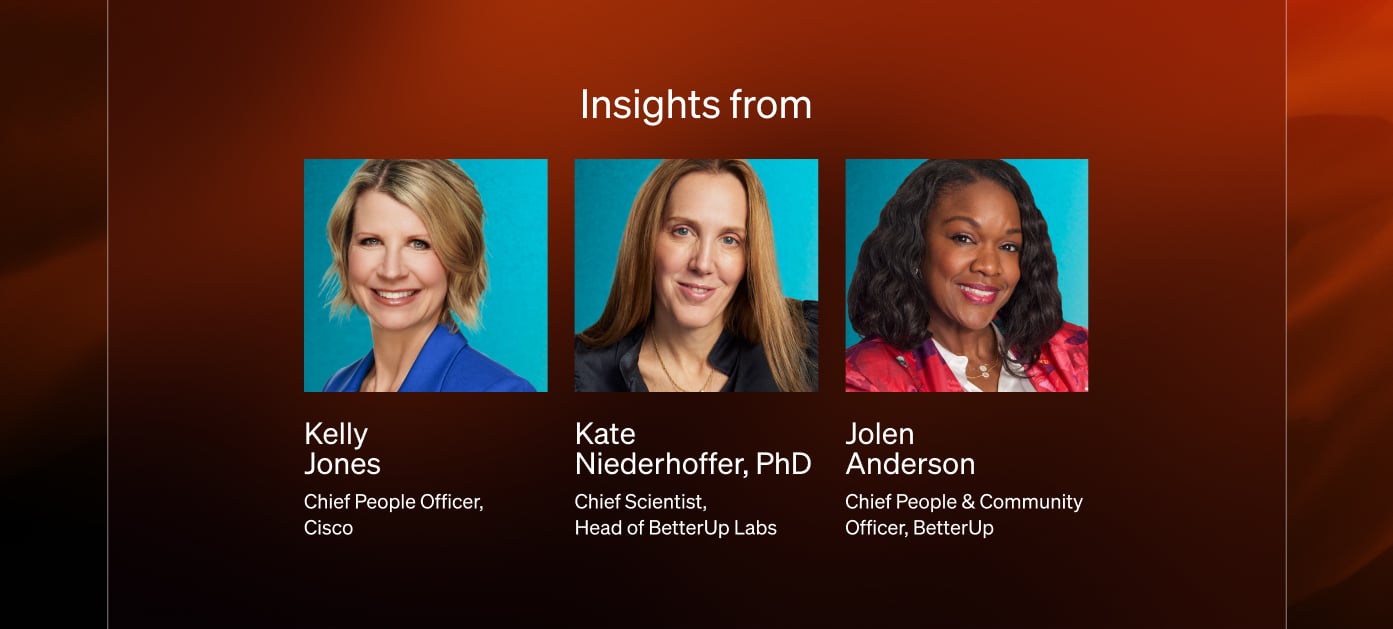
But when Cisco looked closer, its most active AI users reported lower team trust and weaker alignment on shared values. When Cisco Chief People Officer Kelly Jones saw that finding come across her desk, it “kind of stopped me in my tracks a little bit because I wasn’t exactly expecting it,” she told BetterUp Chief Scientist Kate Niederhoffer and BetterUp Chief People & Community Officer Jolen Anderson.
But as she dug deeper she realized, “It’s not actually a technology problem. It was a human psychology and team dynamics problem.”
Why AI adoption rates don’t measure success
AI usage numbers tell you people are using the tool, but they don’t tell you, as Jones put it, whether the work is better, the employee experience is richer, or if teams are collaborating more effectively.
Alongside adoption rates, Cisco measures trust and values alignment, which is how the organization caught the gap. Most companies don't measure team trust, so they wouldn’t have seen the finding and likely would’ve assumed AI adoption was going well.
What is the AI coordination tax?
Indeed, BetterUp research found that while AI helps increase people’s expertise, team trust and coordination fall by more than 20%. Part of that is because of what Niederhoffer calls a “coordination tax.” The coordination tax is the shared knowledge a team loses when people go to AI instead of a colleague, and so stop learning who knows what. When we go to AI because of convenience instead of to a colleague, we skip the relationship building that teaches us who knows what.
What is an AI authenticity gap?
Jones calls what she saw an "authenticity gap,” which can often make us question if a polished piece of work was, say, written by AI or the person who sent it. An authenticity gap is the doubt that sets in when you can’t tell whether a polished piece of work reflects the sender’s own thinking or an AI’s. The real question this brings up: “Can I trust the judgment behind what you just handed me?” Jones asked.
Her answer was to model radical transparency and clear intention. When Jones shared a white paper with her team, she told them up front that an internal AI tool had drafted the story section.
“Technology doesn’t break the trust. Ambiguity breaks the trust.” — Kelly Jones, Chief People Officer, Cisco
How leaders can model responsible AI use
Cisco's internal research found that responsible AI adoption is twice as likely when a team member's manager does it, too. Just like Jones told her team about her white paper, she tells leaders to replace secrecy with shared team norms about when and how to disclose AI use. That’s when AI can become a team multiplier.
Leaders don’t need to be machine learning experts. They just need to be willing to experiment in public, share what went well and what didn't, and be candid about failures. That gives teams psychological safety and makes clear where accountability lives.
4 ways to protect team trust as AI use grows
- Lean into trust and transparency: So much of what makes AI work for a team is understanding who knows what and who’s doing what. “There’s a bit of a lack of authenticity if you’re over relying on AI to do too much of the work for you,” Niederhoffer says. Use team meetings to discuss how AI is helping you do certain types of work, being as transparent and specific as possible.
- Use AI with a relational lens: AI can help you prepare for or enhance your human interactions. If you have a difficult conversation coming up with a colleague, for example, AI can role play that colleague to help you practice what you’d like to say. Don’t use AI as a shield for human interaction.
- Listen for silence: Silence can be a clue that your team may not be staying in regular contact enough. Teams that communicate, even asynchronously, regularly report stronger team coordination (+11%) and team trust (+8%) than those that don’t maintain regular communication.
- Build self-awareness through coaching: Coaching helps people notice when convenience may be steering their decisions. Cisco, which recently deployed BetterUp’s AI coaching trained on Cisco’s guiding principles to its workforce, said more than 20,000 employees engaged with it in the first month.
Cisco’s AI adoption findings are a reminder that just because individuals are using a tool doesn’t mean it's paying off for the people around them. Only when the company measured trust did it learn that its heaviest AI users felt the least trust in their own teams. “The healthiest teams aren’t the ones that are using [AI] the most,” Jones said. “They’re the ones that are designing together.”
Learn how BetterUp helps workforces strengthen team trust and coordination. Request a demo
The Human Transformation Platform
Process doesn't change your business. People do. Our platform removes the guesswork from developing your people at scale and delivers growth that's proven, predictable, and precise.
The Human Transformation Platform
Process doesn't change your business. People do. Our platform removes the guesswork from developing your people at scale and delivers growth that's proven, predictable, and precise.