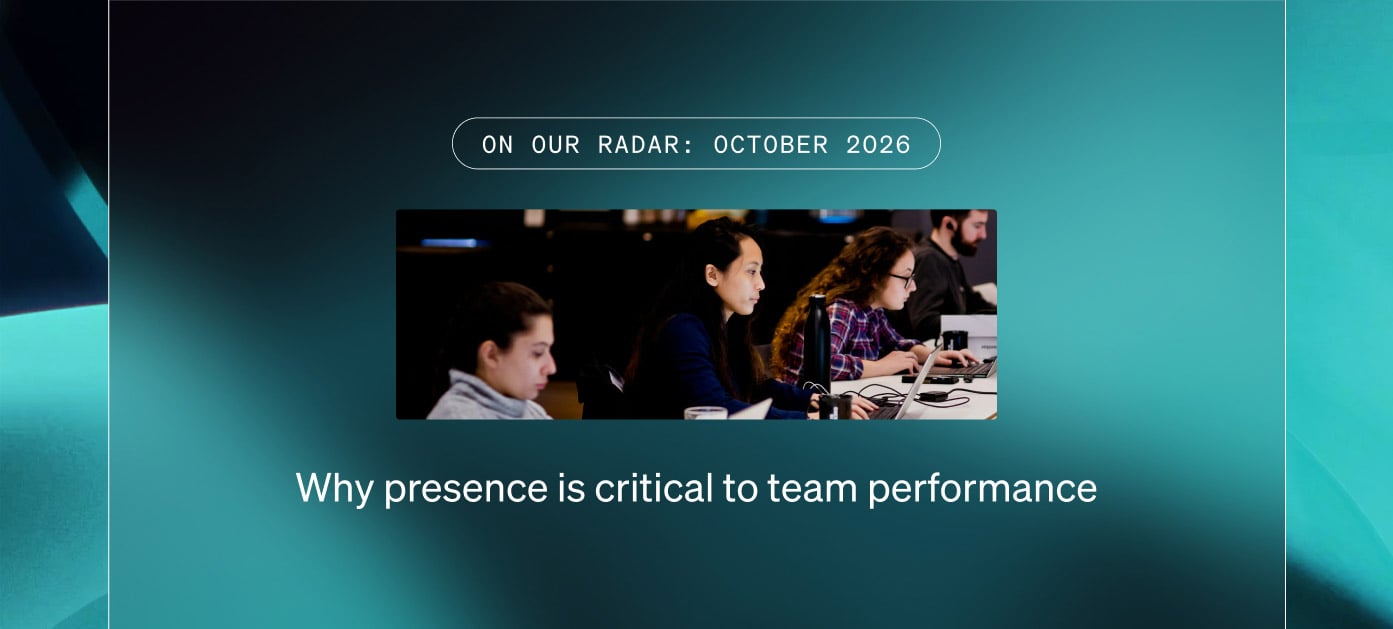
There’s been a movement afoot for people to be more present. Artists and comedians have banned cell phones at shows, urging fans to be in the moment. So have some restaurants and bars.
Now, the call for presence is happening in private spaces, too, and there’s a term that describes what happens when a person reaches for their devices instead of wanting to spend time with their partner: attention infidelity.
Described as “when a partner’s digital life intrudes on an in-person connection,” the term is applicable beyond the realm of romantic relationships. In fact, the same dynamic is happening at work. “Just as a romantic partner may implicitly recognize attention infidelity, workers are also experiencing a feeling of being displaced by AI,” notes Kristina Rapuano, a Senior Research Scientist at BetterUp.
How AI displacement erodes team trust
BetterUp Labs, in partnership with the Stanford Social Media Lab, recently surveyed 1,000 workers and found 20% of AI users report they’re going to AI instead of their colleagues for information or a task, and 49% say teammates come to them less often because they go to AI first.
That shift has a measurable effect: Employees who go to teammates instead of AI are 7.3x more likely to report strong team coordination and 9.5x more likely to report strong team trust than those who go to AI first. “When someone has less visibility into what their team members are working on because they’re leaning on AI instead of each others’ expertise, this can cause distrust, confusion, and ultimately lead to a diminished desire to work together as a team,” Rapuano said.
Why employees go to AI instead of their colleagues
There are several reasons we displace humans in favor of AI. For one, AI is more convenient. It’s always available and it never judges us. There’s no social cost to ask it a question or provide feedback the way there is with human interaction. Just the other day, I found myself starting a chat with a colleague by noting, “I’m embarrassed to even ask this but I’m going anyway.” That type of caveat isn’t needed when interacting with AI.
Then there’s the aspect of sycophancy, or the practice of flattery and validating a person’s thoughts. AI does this magnificently, even when your ideas may actually not deserve such praise.
Going to AI to edit a press release or find a recently used sales pitch may seem harmless at first. But when all those singular use cases compound, there’s a larger effect on organizations. Workers who feel displaced by AI are 3.3x less likely to want to work with their team again, and they're more likely to be looking for a new job. Multiply that result across thousands of people in a workforce and you have a looming turnover problem. For a 10,000-person organization, the cost of displacement translates to $27 million in attrition a year.
How to use AI without losing team connection
Despite concerns over displacement, AI has the potential to help team members broaden their ability to collaborate. As one survey respondent put it, “It can feel a bit mixed because on one hand I’m happy to be able to concentrate on my own work, but also I like helping others and creating connections.” The key to keeping those connections is by using AI with a relational lens:
- Teams benefit when colleagues swap information: In the AI era, swapping of information, project details, and contextual support can still happen, particularly through chat channels in the flow of work.
- Frequent touchpoints protect against displacement: Regular contact with colleagues can buffer against the trust and coordination losses that come when people go to AI first. If needed, leaders can use AI to facilitate these frequent touchpoints — say, by having AI nudge colleagues on messaging channels to reach out to a teammate every few days.
- Psychological safety creates conditions for connection: Our research found teams with stronger psychological safety are 1.65x more likely to be in contact with colleagues multiple times per week. Admitting mistakes, making it safe to experiment, and allowing people to voice their opinions freely can help foster a psychologically-safe environment.
As for that question I was embarrassed to ask? Turns out another colleague had needed similar clarity on the project and was grateful for the discussion, which happened asynchronously. It was a great reminder that sometimes, it really is best to ask a human first.
The Human Transformation Platform
Process doesn't change your business. People do. Our platform removes the guesswork from developing your people at scale and delivers growth that's proven, predictable, and precise.
The Human Transformation Platform
Process doesn't change your business. People do. Our platform removes the guesswork from developing your people at scale and delivers growth that's proven, predictable, and precise.