There’s been a flurry of commentary this month about major tech companies integrating invisible watermarking into their AI tools as a way for readers and viewers to know how much AI was used to, say, write a story or create an image. The developments come in response to regulations including the European Union AI Act, which requires transparency around telling people how much of what they’re interacting with is AI generated.
Proponents of watermarking hail the development as a long-needed step in providing clarity around AI-generated outputs, while opponents argue the technology is easy to tinker with once the content is compressed or edited, rendering the regulation a meaningless compliance checkbox rather than proof of use.
AI fatigue is already here
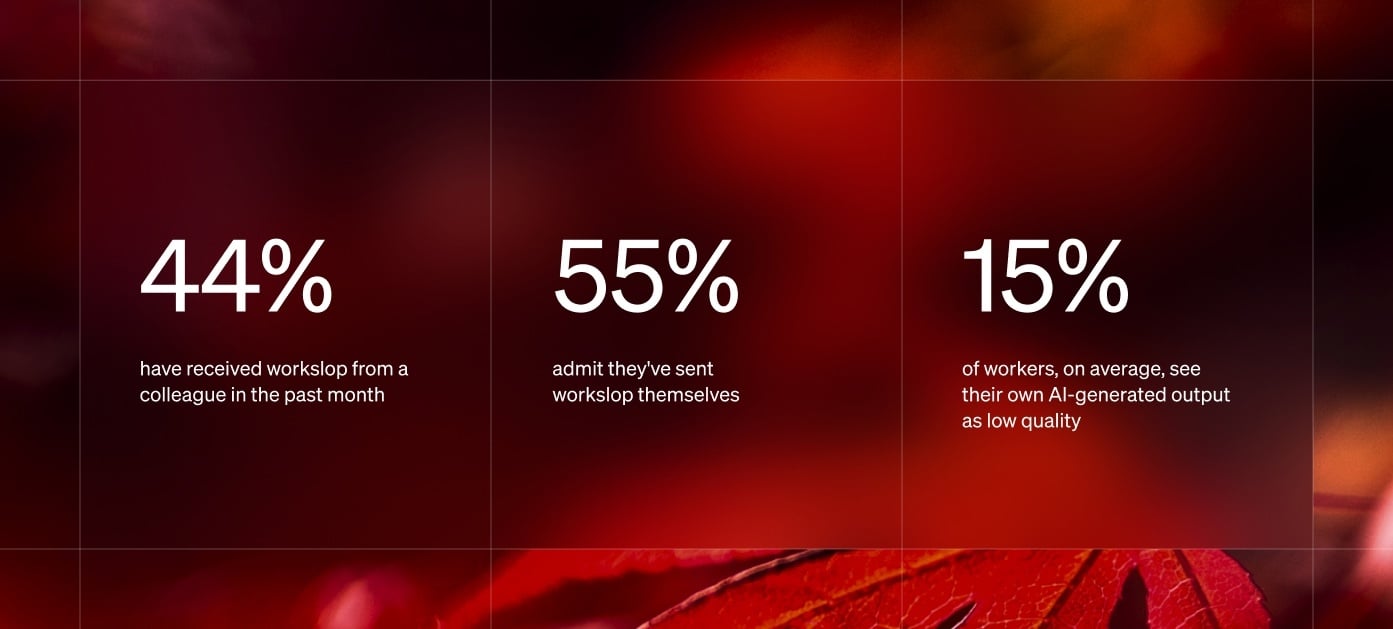
The watermarking comes at a time when fatigue is building around what’s known as “workslop.” The term, coined by researchers at the Stanford Social Media Lab and BetterUp Labs in 2025, is low-quality, AI-generated professional content that mimics real work but shifts the effort of thinking onto whoever has to read it. One social media platform has started allowing its community to report when a post looks like “AI slop,” and a new acronym is making its way around the internet: AI;DR (AI; didn’t read).
The cost of workslop
The exhaustion isn’t just cultural shorthand. Our research shows receiving even one piece of low-effort, AI-generated work lowers a colleague’s opinion of the person who sent it. Multiply that across a team and the “AI;DR” joke starts to look like something closer to a dent in the budget because workslop results in an average of $900 per employee annually.
But the waning of AI enthusiasm is colliding with a much higher stakes deadline from boardrooms. After years of unrestrained AI spending, CEOs are under pressure to show it’s actually working, and the data suggests most aren’t there yet. Only 6% of organizations report any meaningful financial impact from AI at the enterprise level. That’s a slim return given how much has already been staked on the bet that AI adoption will pay off.
Visibility doesn’t equal accountability
In some ways, watermarking strips away the AI halo effect for companies because it sheds light on low-quality content publicly. But it doesn’t fix the actual problem: the absence of an internal system for producing good AI-augmented work in the first place. Most workslop — a rushed internal memo or a bloated slide deck — never even touches the parts of a business the regulations actually govern. The rule only polices public-facing outputs, leaving the bulk of the problem to balloon inside organizations.
The companies that solve the ROI of AI equation correctly aren’t the ones that will pass the EU regulations with flying colors, but the ones that will build internal cultures that have AI guardrails and training that builds people’s confidence and judgment for when to use AI. Getting this wrong already leads to more workslop; employees who are dissatisfied with how their company rolled out AI are more than twice as likely to produce it themselves.
So while some companies fret over what the public may be able to tell about AI-generated work, smarter ones will ask themselves a different question: Can employees tell when AI is being used? And is it being used in a way that fosters trust and team collaboration or erodes the relationships that make a team function well?
An AI watermark can’t tell you that.
The companies chasing AI ROI are asking the wrong question if they're only responding to what the public can see. Compliance with a regulation says nothing about whether a team trusts each other's judgment, or whether people feel confident enough to push back on AI-generated work that isn't good enough. That confidence has to be built inside the company, long before anything reaches a reader or a regulator.


.jpg)