At Web Summit Vancouver, held May 11–14, BetterUp Labs' chief scientist Kate Niederhoffer sat down with Professor and founding Director of Stanford Social Media Lab Jeff Hancock and Axios AI reporter Madison Mills to talk about a problem most leaders can feel but few have named: workslop.
The session tackled a gap most leaders feel but rarely say out loud: despite record AI spending, 95% of organizations report no measurable return. Niederhoffer and Hancock's research points to why: companies have been investing in the tools and skipping the people who have to use them.
What workslop actually costs you
Workslop is AI-generated work that looks finished but isn't. It has the polish of completed work without the substance, so the burden of finishing it lands on whoever receives it.
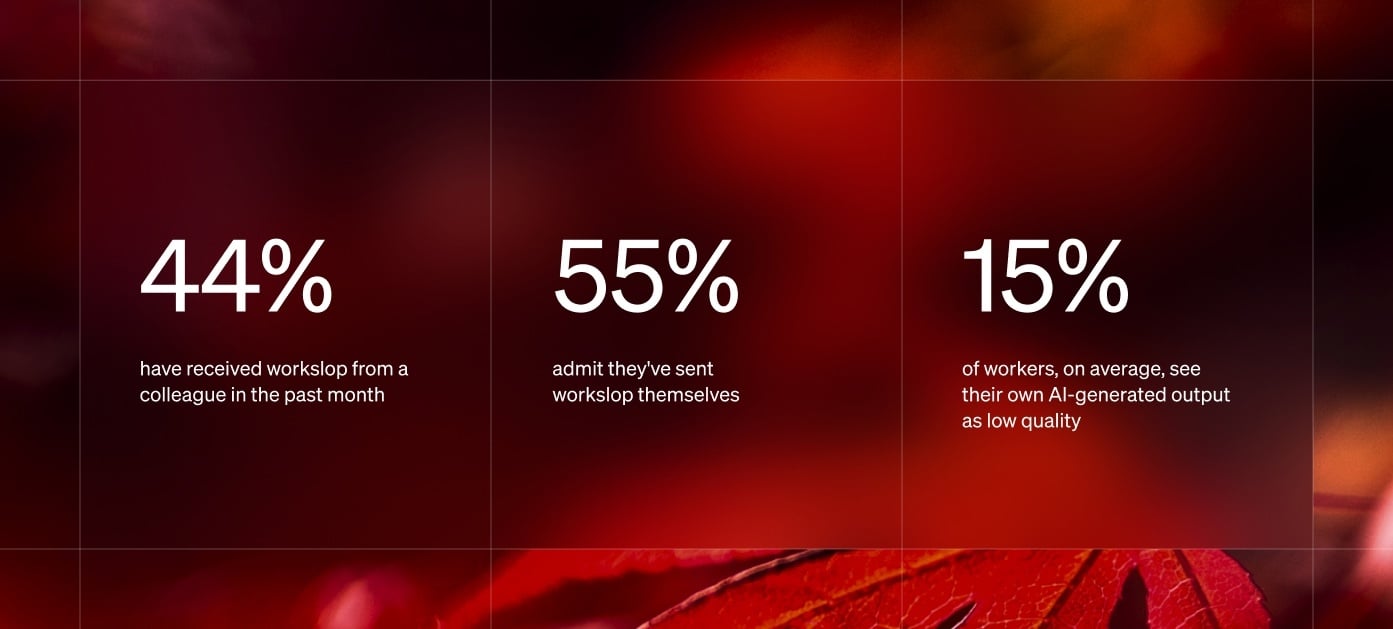
BetterUp Labs measured that burden directly. Between September 2025 and March 2026, BetterUp Labs partnered with Stanford Social Media Lab to survey nearly 2,300 full-time workers and leaders across the US, Canada, and the UK. Among Canadian deskworkers, the findings were telling:
- 44% have received workslop from a colleague in the past month
- 55% admit they've sent workslop themselves
- 15% of workers, on average, see their own AI-generated output as low quality
The cost shows up globally too. Employees spend roughly two hours fixing unhelpful AI output. At a 10,000-person organization, that's over $12 million CAD a year in lost productivity. And one in 10 workers surveyed said half or more of the AI-generated work colleagues sent them was unhelpful, low-effort, or low-quality.
The interpersonal cost runs alongside the productivity one. Approximately half of the people surveyed viewed colleagues who sent workslop as less creative, capable, and reliable than they did before receiving the output. Forty-two percent saw them as less trustworthy, and 36% saw that colleague as less intelligent. That damage compounds workplace relationships and productivity over time.
Why people create workslop
Three conditions predict workslop, and none of them are about the technology:
- Blanket mandates. Requiring employees to use AI — often without the training, agency, or cultural trust to thoughtfully experiment with these powerful new tools — ends up encouraging people to use AI performatively. These low-effort, low-value uses demonstrate compliance with directives to experiment, even as they shift the burden of the work onto the receiver. Hence, workslop.
- Overload. As companies have tightened budgets, consolidated roles, and asked employees to take on more tasks without formal role redesign, individual contributors and frontline managers are stretched more than ever. This has left employees psychologically depleted and juggling heavier workloads.
- Erosion of trust. BetterUp data shows a measurable decline in employee trust since 2020. Leadership communication can counteract this: encouraging AI use makes a healthy adoption six times more likely, but leadership communication that builds trust and clarity makes it 21 times more likely. In the research, trust in one's team reduced workslop by 61%.
Most of the workforce is still in the passenger seat
BetterUp Labs research reveals two types of workers in the AI era: Pilots, known for their unique blend of optimism and agency, are embracing AI at an exponential rate. Their positive outlook on AI's potential for the future, coupled with their confidence to navigate change, positions them as leaders in adapting to this transformative technology. Passengers, by contrast, tend to be pessimistic and have low agency, leading to a general fear of AI and negative feelings toward work. Their reluctance is reflected in minimal AI usage, with many avoiding it entirely in the workplace.
During the panel, Hancock drew a distinction that BetterUp's research backs with data: people either approach AI as a Pilot, staying in control and using the tool to get better at their own work, or as a Passenger, offloading to it and hoping for the best.
Pilots only make up 36% of the global workforce today, and they're the strongest predictor of AI adoption and productivity. Getting more of the workforce into that mindset is worth an estimated $200 million in productivity for a 10,000-person organization. The lever leaders have is communication: employees who say their organization clearly explained why and how to use AI are 21x more likely to become Pilots.
The leaders who get it right pair AI investment with human investment
BetterUp Labs' most recent survey looked at leaders directly. AI is giving them time back: 84% say it saves them 6.5 hours a week on average. What they do with those hours determines whether that time turns into performance.
Leaders who reinvest saved time into building their team's AI capability see 26% higher team AI performance than leaders who don't. That reinvestment matters even more on generationally diverse teams; reinvesting saved time into coaching colleagues and team relationship-building produced a 23% boost in coordination and cut manager burnout by 70%.
Compared with leaders who prioritize AI investment alone, leaders who pair AI investment with human investment — coaching, relationship-building, keeping people aligned — show 17% greater performance, 15% higher team coordination, 21% greater well-being, 18% less burnout, and 35% less workslop.
That gap isn't about technical fluency. It's about how leaders use AI with their people, and the difference shows up sharply in one specific behavior: developmental conversations. Using AI to prepare for a hard conversation increases team coordination by 6%. Using AI instead of having that conversation — sending a colleague to a chatbot for mentorship or career advice — drops coordination by 12%, raises burnout by 26%, and raises intent to leave by 29%.
Culture can even flip the sign on identical AI usage. Leaders with high AI usage inside a high-trust, high-development culture see a 6% performance gain. Leaders with the same usage inside a low-trust, low-development culture see a 9% decline.
See what pairing AI investment with human investment looks like inside your organization.
Talk to BetterUp about bringing coaching and manager enablement to your AI strategy.
The Human Transformation Platform
Process doesn't change your business. People do. Our platform removes the guesswork from developing your people at scale and delivers growth that's proven, predictable, and precise.
The Human Transformation Platform
Process doesn't change your business. People do. Our platform removes the guesswork from developing your people at scale and delivers growth that's proven, predictable, and precise.
.jpg)