This is the second post in a four-part series on the organizational conditions that determine whether AI adoption produces real performance. You can find the first post on AI manager archetypes identified in BetterUp Labs research here.
When BetterUp Labs and Stanford University's Social Media Lab researchers studied what predicts low-quality AI output — content that looks polished but lacks substance and creates more work for others — they found that the biggest predictors weren’t individual traits, but environmental factors: whether AI was mandated or encouraged, how much trust existed in the organization, and how leadership communicated about AI.
The finding has a direct implication for how organizations design their AI rollout. How leaders communicate about AI, and whether those statements are consistent with actual decisions, shapes behavior across the entire organization.
The mandate problem
When leaders frame AI use as compliance — demonstrate proficiency by the end of quarter or hit an adoption rate target — employees are significantly more likely to outsource their thinking to AI. When leaders frame AI as a tool for growth and exploration, the conditions for genuine experimentation between AIs and humans take hold.
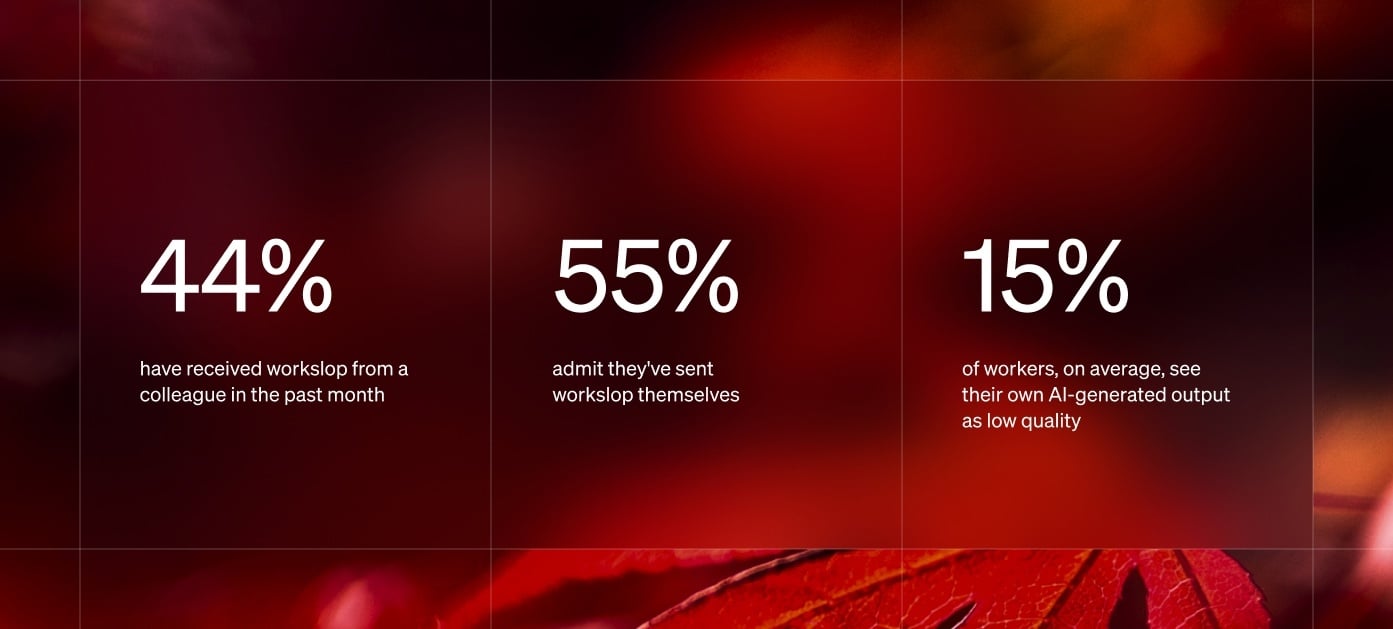
Our research found that the biggest predictors of workslop (low-effort, low-quality AI-generated content) was when organizations mandate the use of AI. Mandates ranked higher than other predictors, including low psychological fuel, low psychological safety, and low AI agency. Personality traits ranked last. (Source: Liebscher, Lee, Rapuano, Kellerman, Niederhoffer & Hancock, 2026 preprint)
Two approaches to accountability
When Pfizer looked to design their AI rollout, the organization focused on a simple, but impactful question before they even picked a tool: where would the accountability live?
"We had a lot of debate," said Albert Bourla, Pfizer’s chairman and CEO. "Shall we use a centralized system and bring visionary AI leaders that will tell us how to do it? Or go all the way the opposite — give them the resources, but also the responsibility and accountability to transform the way that they operate?”
They went with the second one because they recognized that centralized expertise would produce a program, but accountability distributed across the organization would produce the conditions that develop Calibrators (managers who use AI as a tool for performance rather than compliance).
Greg Case, CEO of Aon, made a related distinction when describing his company's goal for its 60,000 employees across 120 countries: "Our goal is not 30,000 colleagues doing the same work,” he said. “Our goal is 60,000 colleagues better equipped than ever before to drive outcomes we could have never driven."
The signal employees receive
The way Case and Bourla describe their AI rollout designs signal a very different message than “find efficiencies." Research by Stanford's Jeff Hancock, BetterUp Labs' Kate Niederhoffer, and Oxford's Jan-Emmanuel De Neve found that employee perception of whether an organization is on the automation or augmentation path has real downstream consequences. "If you're really just automating, people figure it out," Hancock noted. “When employees watch a company invest in AI tools while quietly reducing headcount, they don't hear augmentation. They hear: we're keeping you until the tool is ready.”
Moreover, high trust in leadership increases your organization's odds of landing on the augmentation path rather than the automation path by 46%. As Salesforce Chief Equality and Engagement Officer Alexandra Legend Siegel found, inclusion correlated strongly with AI readiness: employees who feel more included and engaged are 58% more likely to be confident with AI. Framing AI adoption as a democratization of capability shifted how employees experienced the transformation.
Every message about AI sends a signal and tells your people whether this transformation is something being done to them or something they’re part of.
When leadership makes a deliberate decision about how to frame AI rollouts from the beginning, instead of letting it be an afterthought, performance doesn’t stall.
BetterUp research identifies the organizational conditions that predict AI performance. See the full findings.
The Human Transformation Platform
Process doesn't change your business. People do. Our platform removes the guesswork from developing your people at scale and delivers growth that's proven, predictable, and precise.
The Human Transformation Platform
Process doesn't change your business. People do. Our platform removes the guesswork from developing your people at scale and delivers growth that's proven, predictable, and precise.
.jpg)