Many organizations measure the success of AI adoption by calculating usage rates, token consumption volume, and training completion rates. But these metrics won’t tell you if your AI investments are paying off.
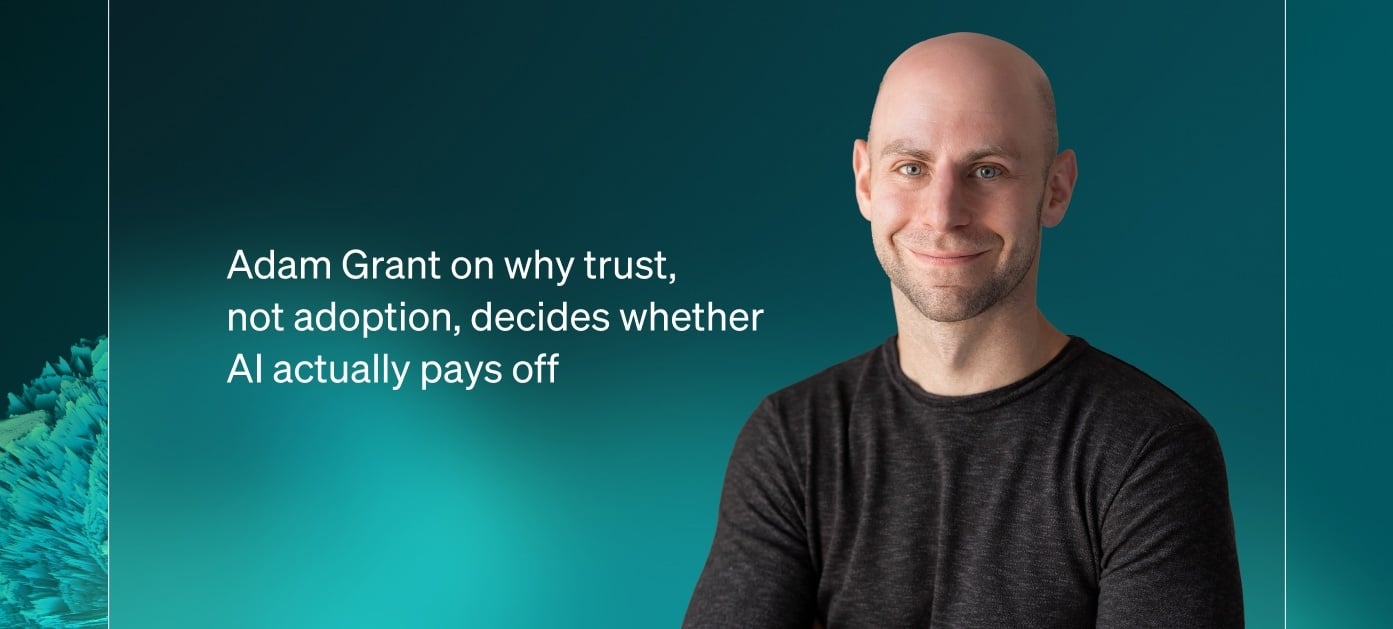
These are the key takeaways from a recent conversation between Adam Grant and BlackRock's Caroline Heller, moderated by BetterUp's Jolen Anderson, on why companies keep investing in AI without building the trust to use it well.
In a BetterUp Labs study of 580,000 workers, trust in leadership, not adoption, predicted whether AI lifted performance. As BetterUp Chief People and Community Officer Jolen Anderson put it, “Trust turns AI usage into real experimentation, learning, and ultimately the thing we all care about — results.”
What builds trust in AI adoption?
Trust breaks down into two categories, according to Adam Grant, organizational psychologist and Chair of the BetterUp Center for Purpose and Performance:
Competence
- Capability: Are you good at what you do?
- Reliability: Are you consistent and follow through?
Character
- Benevolence: Do you care about my best interests?
- Integrity: Are you going to do the right thing?
Capability and reliability are easier to demonstrate. But benevolence and integrity are more telling.
“If people doubt your intentions or integrity, they won’t engage with AI.” –– Adam Grant
Cognitive debt vs. cognitive dividend
Cognitive debt and cognitive dividend are two opposite outcomes of AI use — here's the difference.
What is cognitive debt?
Cognitive debt is the result of outsourcing thinking to AI. This erodes critical and creative thinking over time.
What is workslop?
Workslop, or AI-generated content that looks polished but actually offloads the real thinking to the recipient of the work, is the tangible output of this debt.
- It takes two hours of work to clean up each act of workslop.
- “It’s a huge tax to put on somebody,” Grant said.
What is a cognitive dividend?
A cognitive dividend is the payoff of a deliberate partnership between AI and humans, resulting in a wider range of ideas and reframing of perspectives. When done well, dividends compound:
- Volume: Generate a wider range of ideas before narrowing in, instead of settling on the first idea that sounds good.
- Reframe: Reposition the same idea to resonate with a different audience.
- Blind-spot analysis: Surface gaps in your reasoning or understanding that you didn’t know you had.
What determines whether your team's AI use is a debt or dividend?
Judgement. It's what decides whether you trust an AI output or challenge it.
Judgement shows up in how you use AI, not just whether you use it. Ask for 100 ideas instead of 10, then pick the best three and edit them before presenting them to a colleague. That's judgement doing the filtering AI can't do for you.
One way to test judgement and build it over time:
- Pick a handful of predictions about how AI will change your business this year.
- Assign a confidence level to each, and revisit the scorecard in 12 months.
- Do this enough times and your calibration sharpens, allowing you to understand when to trust your gut.
Three places to start building ROI with AI
- Kill workslop with explicit guardrails. Decide — and put in writing — when AI can be used and what human oversight is needed to ensure a curated, polished product comes out instead of raw, unrefined output.
- Close the loop on listening. Pair engagement surveys with live conversations. If the answers diverge significantly, it’s an indicator that you have an AI implementation trust problem. People need to know they’ve been heard, even when they don’t get their way.
- Build a forecasting habit. Pick a handful of concrete predictions about how AI will change your business and experiment with forecasting. Remember that testing predictions only works if people feel safe doing it. As BlackRock’s Caroline Heller puts it, part of the job is “making it safe to experiment and to get it wrong.”
Adoption is something you require, but trust is something you have to earn. Earn it, and people feel safe enough to point AI at the problems that actually matter. As Adam Grant notes, "AI succeeds when people are empowered to use it to solve real problems they care about."
Learn how BetterUp helps leaders turn AI into real ROI. Request a demo.
The Human Transformation Platform
Process doesn't change your business. People do. Our platform removes the guesswork from developing your people at scale and delivers growth that's proven, predictable, and precise.
The Human Transformation Platform
Process doesn't change your business. People do. Our platform removes the guesswork from developing your people at scale and delivers growth that's proven, predictable, and precise.
.jpg)


