Most organizations tracking AI progress are running some version of the same dashboard: active users, prompts submitted, and hours saved. These feel like the right numbers to report because they show activity. But they actually measure the wrong thing.
New research from BetterUp Labs suggests the metrics most organizations watch are lagging indicators of something deeper: the conditions your organization has built around AI usage. If you foster the right conditions, AI adoption becomes augmentative, driving performance, retention, and innovation at the same time. But without the right conditions, what looks like progress can erode the very outcomes you're trying to achieve.
Hidden signals
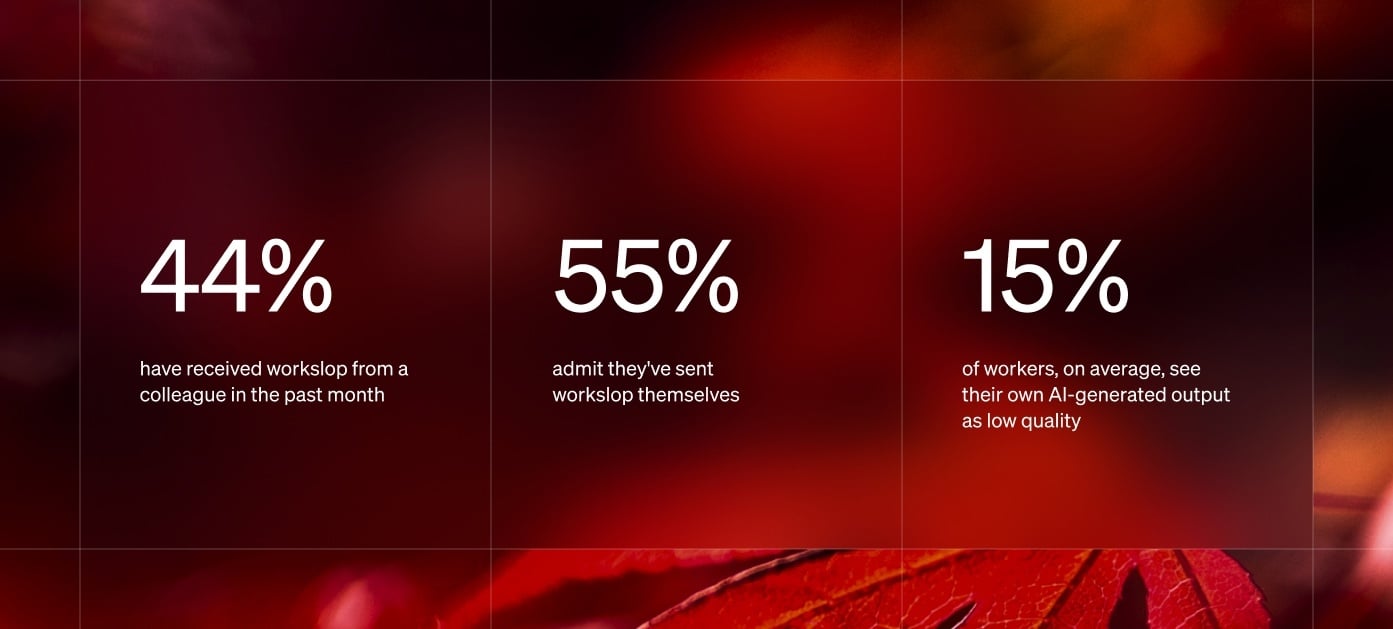
The research found that more than 50% of employees admit to producing workslop — low-effort, low-quality AI-generated content submitted as finished work.
It’s easy to interpret that number as an individual performance problem, but it’s actually a an environmental problem. When researchers at BetterUp Labs modeled what actually predicts workslop, individual characteristics barely showed up. What predicted workslop were conditions in which employees were asked to use AI. This could look like an environment where people couldn't admit they didn't know how to use AI tools or a lack of investment in the skills required to use AI well. After all, deploying a 40-minute AI tutorial company-wide doesn’t exactly set workers up for success.
In other words, our research found that workslop can be used as a diagnostic. So if you see it in your organization, the question to ask isn’t, "why aren't my people trying harder?" It's "what conditions did we build that made low-effort output the rational choice?"
Same adoption score. Opposite outcomes.
To understand the impact of conditions, BetterUp studied managers with identical AI adoption scores — same tools, same usage frequency — and found they were producing opposite outcomes on adaptive performance, team coordination, and burnout. The adoption metric told the same story for both groups, but the actual results couldn’t have been more different.
What explained the gap was how managers were allocating their attention. The managers who were burning out and underperforming were using AI at high volume, but using it to displace human interactions instead of supplement them. They were using AI to draft performance reviews, for example, instead of having actual conversations with direct reports, or generating meeting summaries instead of showing up for them. What’s more, the most burned-out managers were tokenmaxxing — consuming as much AI as possible as a signal of output.
Conversely, the managers producing the best results were using AI at high frequency and investing in human leadership behaviors like coaching, giving direct feedback, and having difficult conversations. AI handled the preparation but the human handled what the preparation was actually for: an interaction.
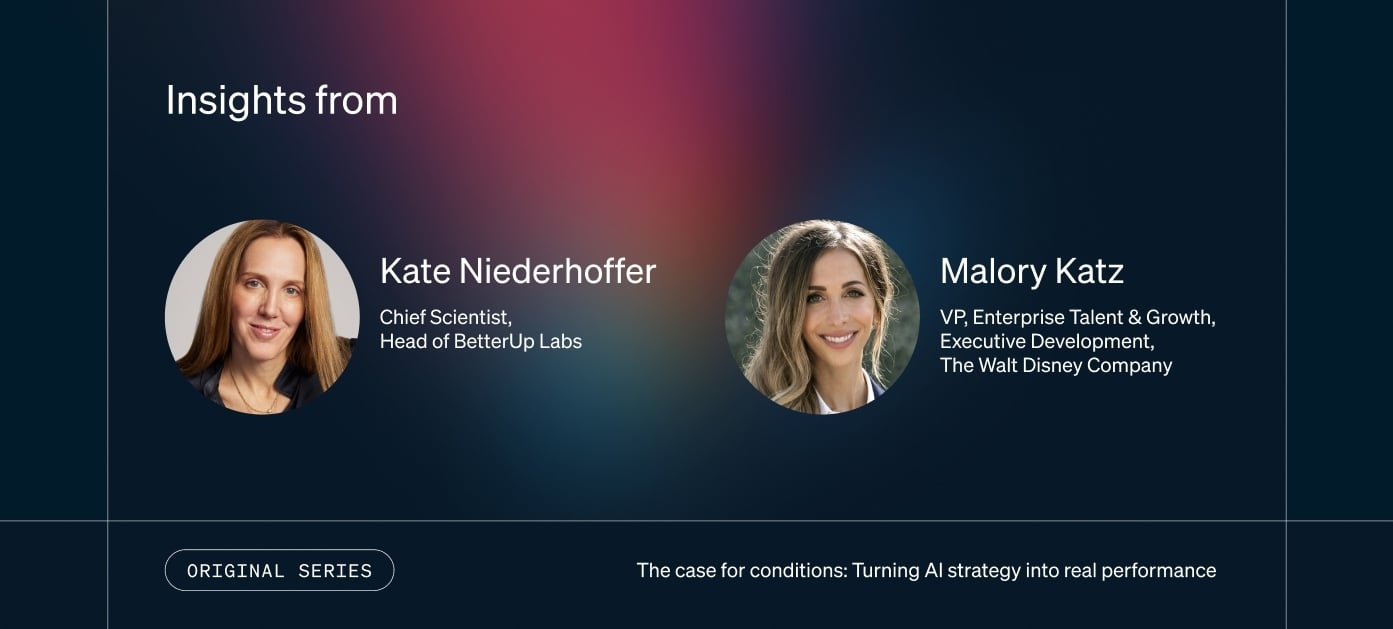
Malory Katz, VP of Talent and Growth at The Walt Disney Company, described how this AI-human collaboration can work well in the context of year-end performance reviews. She noted how she used AI to generate thoughtful questions to ask employees that she wouldn’t have thought to ask and then showed up fully to the conversation with those questions. The output was better, and it came from a human who stayed in the room.
The one condition to start with
If you have a limited budget and limited time — which is most organizations — BetterUp Labs chief scientist Kate Niederhoffer has a clear answer on where to start with conditions: mattering.
Mattering isn’t the same as engagement, though the two are frequently conflated. Engagement is involvement and energy. Mattering is a deeper belief that your work will have an impact, and that the people it serves will be better for it. It has an interpersonal dimension that engagement doesn't. For example, you can be highly engaged doing work that feels pointless. But mattering requires a connection between your effort and an outcome that matters to someone.
That distinction becomes critical in an AI environment, because AI creates the conditions for anti-mattering signals at scale. When your organization deploys the technology without explicitly and credibly communicating that people still matter — that their judgment, courage, and relationships are what the tools are there to support — the default interpretation many employees reach is that they're being automated. The antidote isn’t a communication campaign. It's building a culture where people experience mattering in the day-to-day texture of the work via feedback, how leaders share what they’re learning and how organizations respond when someone makes a mistake with a new tool.
What to put on your AI dashboard instead
Niederhoffer recommends building your measurement framework around conditions and capacities rather than behavior counts. Specifically, she recommendations tracking the following individual capacities:
- Courage and curiosity (not just self-reported skill levels)
- Agency — whether people believe they have meaningful control over how they use these tools
- Mattering scores, tracked over time as conditions change
At the same time, she recommends measuring the following conditions as levers:
- Psychological safety: Can people ask questions, make mistakes, and give honest feedback about how the tools are working?
- Learning culture: Is growth happening and being recognized, or are people expected to arrive already proficient?
- Trust in leadership: Do employees believe the organization's stated commitment to development is real?
There is a version of AI strategy that treats this moment as a cost-cutting opportunity: fewer people doing the same work, automated at the margins. That path shows up cleanly on a spreadsheet.
But there’s another version that asks organizations to invest in their people while deploying the tools instead of using the tools to replace them. That’s the path where the return on AI investments and the return on people investments compound together rather than trade off against each other. So as your organization continues down the AI path, the question to ask is if you’ve created the conditions for the kind of AI usage that actually produces ROI — or hinders it.
BetterUp Labs research on AI conditions and workforce readiness was presented at Uplift 2026. To watch the full discussion with Kate Niederhoffer and Malory Katz from The Walt Disney Company, Watch the recording.
The Human Transformation Platform
Process doesn't change your business. People do. Our platform removes the guesswork from developing your people at scale and delivers growth that's proven, predictable, and precise.
The Human Transformation Platform
Process doesn't change your business. People do. Our platform removes the guesswork from developing your people at scale and delivers growth that's proven, predictable, and precise.
.jpg)