In 2020, 1,460 adult volunteers in the United States signed up through an online research platform to talk with a stranger over video. Some talked with more than one partner, for a total of 1,656 conversations. They were paid for their time, and each agreed to let researchers study and share the recordings. In 2022, BetterUp Labs released those conversations as the CANDOR corpus to give psychologists and linguists a look at what makes conversations work. (It contains no BetterUp customer, member, or coaching data.)
Fast forward four years and CANDOR v1.1 is now on Hugging Face. It has new transcriptions and a better way of splitting talk into turns, and it fixes errors we found in the original files. For the first time, the license allows commercial use.
Why we built CANDOR
Coaching is a conversation, so at BetterUp we care a lot about what makes conversations work. But the available science hadn’t caught up with the digital era. Most recorded conversation datasets were too small or scripted to offer real insight, or they came from phone lines with no video, making it hard to pick up on non-verbal cues.
CANDOR has about 860 hours of unscripted talk, roughly 9.8 million words. Each call has video and audio lined up with a transcript. Right after hanging up, both people filled out a survey about how the conversation went and what they thought of their partner. We hoped psychologists and linguists would find it useful. It went much further than that.
A dozen fields, one dataset
As of November 2026, the CANDOR paper has 244 citations on Google Scholar. In October, we read every citing paper whose full text we could get. Of those 155 papers, 91 worked directly with CANDOR's data, either to train models, test them, or study people. Another 21 papers used CANDOR conversations through a benchmark built from them, without citing CANDOR itself.
Every dot is a paper that builds on CANDOR. Distance from the center shows when it came out, from early 2023 to late 2026. Each slice is a field, and color shows how the paper uses CANDOR. Source: BetterUp Labs review of papers citing Reece et al. (2023) on Google Scholar, October 2026.
Those papers span at least a dozen disciplines, from voice AI to anthropology to art.
Voice AI: The largest group of papers builds “full-duplex” voice systems, which listen and talk at the same time the way people do. Research teams at Meta and Microsoft Research have trained models on CANDOR, teams at Tencent, Qualcomm, and KRAFTON have tested on it, and Huawei and NTT built their benchmarks from it. Full-Duplex-Bench, a widely used test for these systems, relies heavily on CANDOR clips. CANDOR is valuable because it's made of authentic human conversations, with all the dynamism and messiness of real people learning to connect — exactly what most scripted audio misses. That's what makes the CANDOR corpus such a meaningful boost to AI progress.
Language science: Claire Bergey and Simon DeDeo used CANDOR to estimate that conversation carries about 13 bits of information per second. They found that listeners’ “yeah”s and “uh-huh”s tend to come when that flow dips. Thomas Clark and colleagues showed that speakers put extra stress on the words a listener is least likely to predict.
Psychology: People who lie tend to assume others are lying too, which makes it harder for them to connect (Sprigings et al., Communications Psychology, 2023). People with higher social status act more like themselves (Bailey et al., Personality and Social Psychology Bulletin, 2025). A December 2025 Nature paper by Melanie Brucks and colleagues, which included an analysis of CANDOR”s calls, found that small video-call glitches make people seem uncanny, enough to hurt hiring decisions. BetterUp Labs has found a similar pattern at work: teams that turn to AI before each other report lower trust.
Anthropology: A team that includes biological anthropologist Robin Dunbar went back to CANDOR participants and asked about their friendships. People whose faces were more expressive in conversation had more one-on-one friendships, and expressive women also had larger, more diverse networks (Kavanagh et al., iScience, 2026).
Avatars, art, and storytelling: Engineers have trained 3D avatars on CANDOR to react like real listeners. Computer-music researchers turned its conversations into a live sound performance called String Theory, where the audience takes part. In June 2025, The Pudding, which publishes visual essays, built an interactive story from CANDOR’s conversations.
In researchers' words
“Having access to naturalistic conversations at this scale, with such rich, well-processed, and clearly organized multimodal data, is incredibly rare.” — Dong Won Lee, MIT Personal Robots Group
"It is one of the best-organized public datasets we have worked with, and we regularly recommend it to other researchers." — Melanie Brucks and Jacqueline Rifkin, Columbia Business School and Cornell University
“We could measure, for the first time, true conversation bit-rates.” — Simon DeDeo, Carnegie Mellon University and the Santa Fe Institute
“With CANDOR I have been able to add studies to my papers that have a balance of ecological validity, with lab-level precision of variables.” — Erica R. Bailey, UC Berkeley Haas School of Business
“It's likely that we've only scratched the surface of the cognitive and behavioral insights that can be gleaned from CANDOR.” — Thomas Hikaru Clark, New York University
A global research tool
Everyone who uses CANDOR applies for access, so we can see where it’s being used.
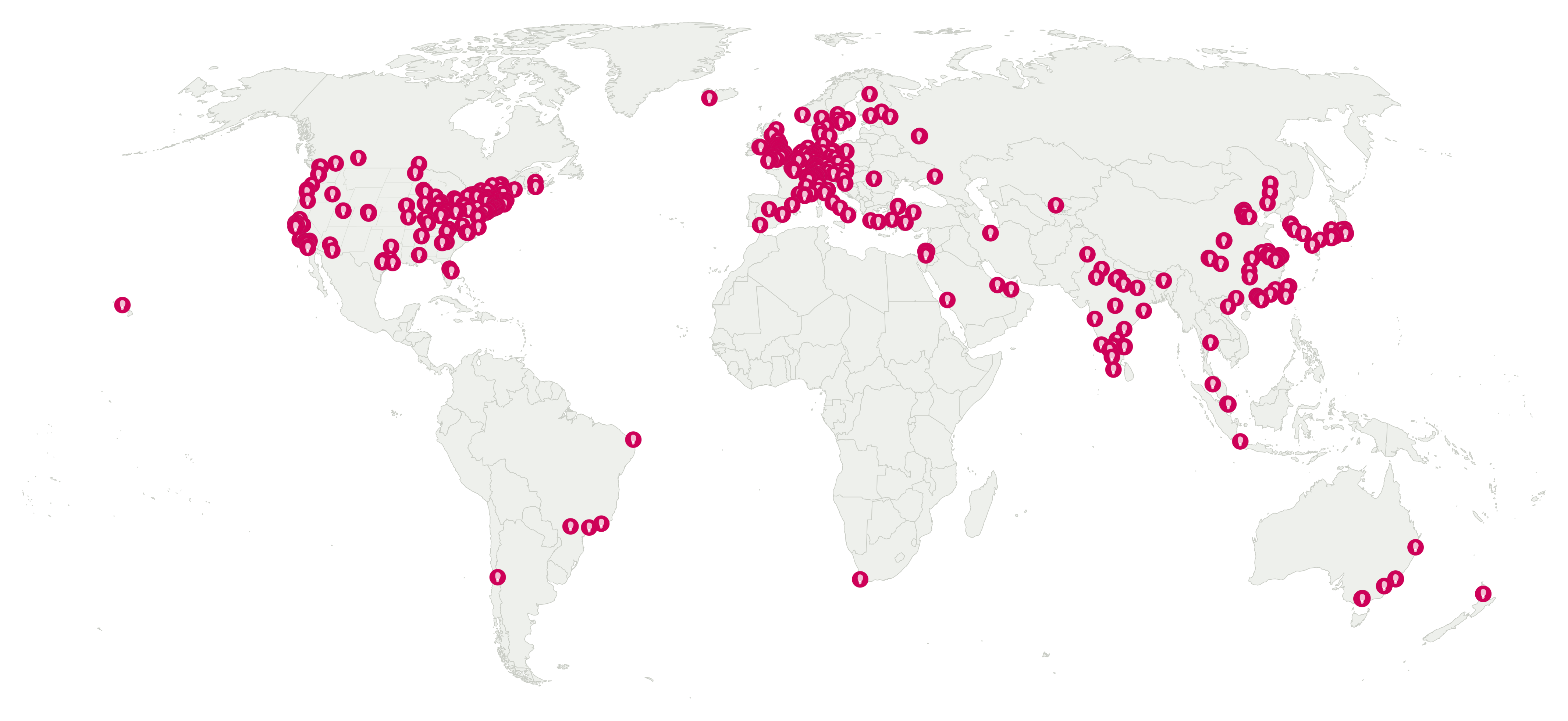
Each pin marks an institution where at least one researcher has been approved to use CANDOR since 2022. As of November 2026, that's nearly 1,200 researchers at about 490 institutions in more than 40 countries.
What's new in CANDOR
New transcriptions: We re-transcribed every conversation in January 2024 with AWS Transcribe. The new transcripts give a confidence score for every word.
NaturalTurn transcripts: Speech-to-text services split conversation into fragments. Every time the listener says "mm-hm," the transcript starts a new turn and cuts the speaker's sentence in two. NaturalTurn, published in Scientific Reports in 2025 by Gus Cooney and Andrew Reece, keeps each speaker's turn whole and stores the listener's “mm-hm”s alongside it. Version 1.1 includes NaturalTurn transcripts for every conversation. We also rebuilt the three original turn formats from the new transcription, so all four now start from the same words.
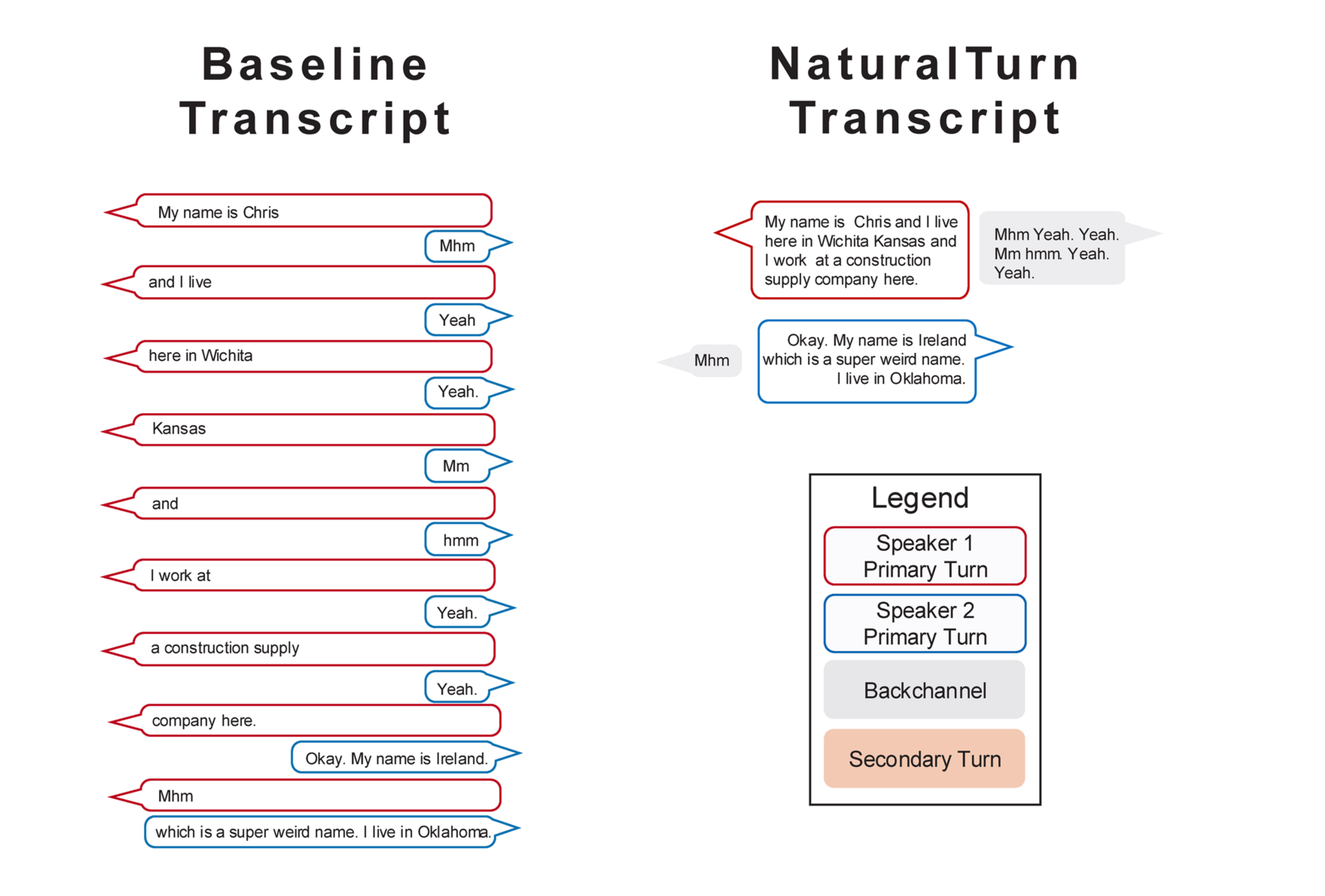
The opening of a CANDOR conversation, split two ways. A standard transcript breaks the first speaker's introduction into eight pieces around the listener's “mm-hms and “yeah”s. NaturalTurn keeps each introduction whole. Source:Adapted from Cooney & Reece (2025), Scientific Reports.
Fixes: An error in v1.0 put video features later in the conversation than they happened, for 2,922 of the 3,312 participant recordings (two per conversation). For one-third of them, the delay was a minute or more. If you lined up v1.0 video with speech or transcripts, please rerun that analysis on v1.1. We also fixed sound features measured on silent padding, and survey scores that wrongly recorded as zero.
A new license: The updated CANDOR Corpus License now allows research, development, and commercial use, free of charge. It doesn't allow redistributing the data, identifying participants, building voiceprints or face prints, or making synthetic media that imitates a participant.
Why CANDOR now allows commercial use
The field using CANDOR the most is building voice AI that can hold a real conversation. Those systems have to know when to speak and when to wait, and to tell when an “mm-hm” means “keep going.” Learning that takes recordings of real people talking, collected with consent, at scale. Until v1.1, the license ruled out commercial use, so companies building these systems couldn't use CANDOR. In the first two days after we opened access on Hugging Face, we approved 20 applicants, and 13 of them work at companies.
Hugging Face also makes CANDOR easier to find. It comes in three versions:
- Tabular (about 11 GB): transcripts, turn tables, surveys, and metadata
- Processed (about 350 GB): audio, plus features measured from the audio and video
- Raw (about 950 GB): the original video and audio recordings
How to get access to CANDOR
Request access at huggingface.co/collections/betterup/candor-corpus with your email, a work or school address if you have one, and a few sentences about how you plan to use the data. We email a link to confirm the address before access opens.
If you use CANDOR or any benchmarks that include CANDOR data, please cite Reece et al. (2023), Science Advances. If you use the NaturalTurn transcripts, please also cite Cooney & Reece (2025), Scientific Reports. Questions go to datarequests@betterup.co.
Thank you to everyone who has built on CANDOR so far.
See how BetterUp’s AI Coach remembers each person’s growth, not just their facts. Talk to BetterUp