AI is reshaping how work gets done faster than most organizations can track. The last time change moved at this speed and this scale across every industry simultaneously, it was 2020.
The pandemic gave leaders a deadline. Overnight, the fundamental questions of how we work, who we work with, and what the work even is were all in play at once. The organizations that navigated it best were the ones that had invested in developing an agile, resilient workforce.
When Moderna’s COVID-19 vaccine work required the business to scale faster than any conventional talent strategy could support, they rewrote their rules for scaling leadership under impossible pressure. The people question immediately became the strategic question, and the result they produced is a model for what organizations now navigating AI-driven change need to understand.
Why Moderna built its leadership system from research, not a playbook
Moderna's vaccine work created a growth challenge most organizations never face: it went from about 800 people in the United States to approximately 5,000 people around the globe during the pandemic. The business was scaling fast. High-performers were being elevated into management roles before the development infrastructure was built out to support them. They had to quickly find a way to upskill their people at scale, but they were determined to do it without compromising the unique characteristics of Moderna’s culture that they knew drove the motivation and innovation that a biotechnology company requires to be successful. To do this, they chose to build their own framework for workforce development rather than importing one from someone else’s playbook.
Working with BetterUp, Moderna ran a research study across more than 2,000 employees, including interviews and quantitative surveys, to surface the specific behaviors and mindsets that define high performance inside their culture. That study produced 13 performance drivers — a combination of Moderna-specific competencies and BetterUp Whole Person™ capabilities — that became the backbone of everything built after it.
For Tracey Franklin, Moderna's Chief People and Digital Technology Officer, the research foundation wasn't optional. "With this BetterUp collaboration, we can surface insights that enable us to drive performance in exponential ways at scale. Across every market, level, region, and role, we're going to have a way of thinking about performance, growth, and development that's Moderna specific."
That specificity matters. Franklin draws a direct line from what Moderna built for rapid COVID-era scaling to what every organization now faces with AI: "As AI progresses, the human capability around it has to evolve in parallel."
How coaching helped Moderna's team members make the shift to leading people
The individual contributor-to-manager transition is where many technically excellent organizations lose ground. For scientists trained to treat data as the ultimate currency, the skills that made them exceptional individual contributors don't automatically transfer to leading people.
Andre Araujo, Executive Director of Medical Real World Evidence at Moderna, described the shift: “As a scientist, facts rule the day. But through BetterUp and with Moderna's support, I learned that having the facts matters, but they don't always land unless you get the context right. Understanding your audience, reading the tone in the room, being perceptive to the softer signals that technical experts sometimes dismiss — those things are crucial to becoming a good leader here.”
The change went beyond just communication style. “BetterUp coaching helped me shift from trying to solve everything myself to thinking about problems from a systems perspective,” said Wei Zheng, Executive Director of Oncology Bioinformatics. “I built a new habit to pause and reflect, not to solve the problem in front of me, but to solve this kind of problem with a new system in place.”
That habit became contagious. Wei's team now handled strategic decisions and external stakeholder engagement independently. “If managers learn trust and authenticity through their coaches and lead by example, that ripple effect moves through team leads, skip levels, and the entire organization.”
Managers who completed coaching also handled organizational change differently. They can, as Wei puts it, “draw on their coaching experience to help themselves and others navigate the mental journey of aligning with new strategy. That agility, multiplied across the organization, makes us genuinely more resilient as a company.”
How real-time data replaced episodic training at Moderna
One of the most significant shifts for Moderna was visibility.
“BetterUp has helped us evolve our investment in employees from episodic, one-time events to an ongoing personalized journey," said Molly Nagler, Moderna's Head of Learning. "We now have real-time data on what our employees are experiencing, where they're getting stuck, and what they need.”
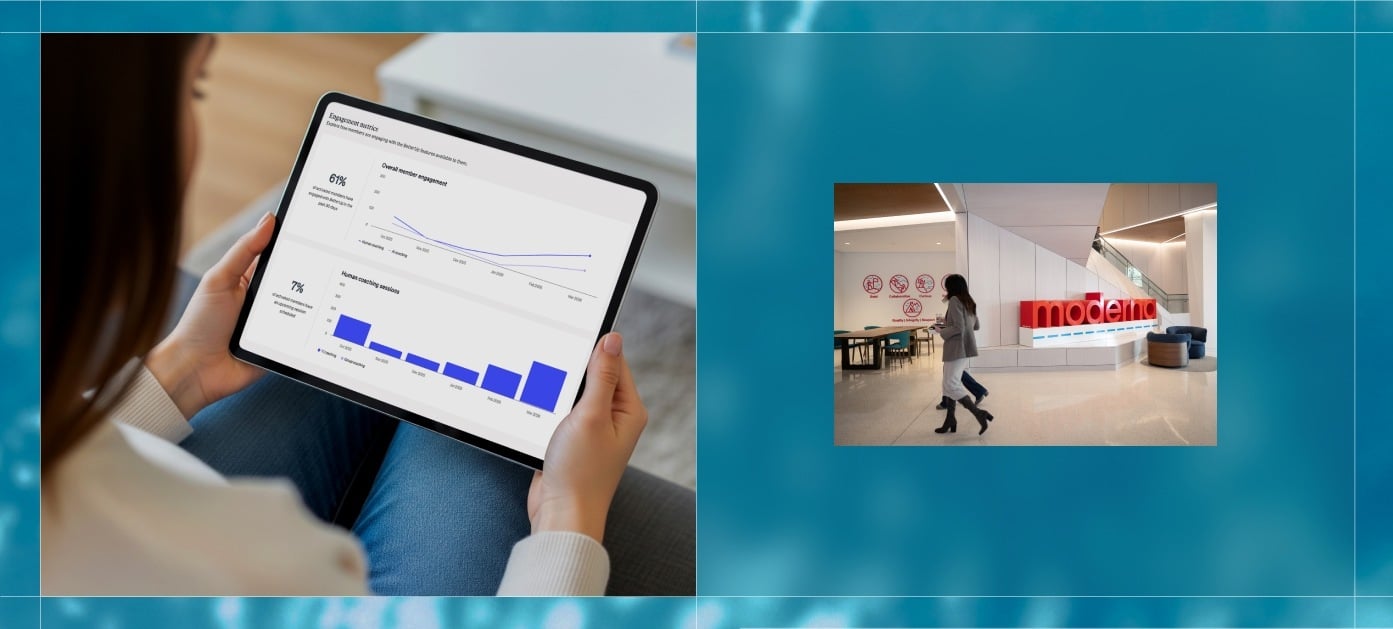
That data loop is also how Moderna knew the system was working. BetterUp's dashboard gave them a real-time view of the organizational hotspots surfacing in coaching conversations — which skills were trending, which workforce challenges were intensifying, and where to act next — replacing the guesswork of annual surveys with evidence they could use to make smarter decisions, demonstrate bottom-line impact, and optimize the program over time.
“When we focus on human development, we're thinking about agility with change – learning and unlearning so people can develop new habits and adjust to a dynamic environment.” — Molly Nagler, Head of Learning, Moderna
What Moderna's leadership investment produced
Work-life balance increased by 18%. Team resilience increased by 15%. Goal attainment increased by 17%. Team cohesion increased by 16%.
These are performance indicators that compound. A team with stronger cohesion moves faster, weathers change better, and holds together when it needs to.
"Resilient, happy, productive employees working hard against their goals and actually achieving them. With BetterUp, we can do both at scale." — Molly Nagler, Head of Learning, Moderna
What CHROs can take from the Moderna model
Franklin's framing of the AI challenge applies to every organization navigating this moment: "AI is not a technical problem. The technology is actually the easy part. The hard part is data, process, change management, and figuring out how people and AI will work together."
Moderna's answer to that challenge was a system designed from their own data, built around their own culture's definition of high performance, and sustained through ongoing development rather than one-time events. The 13 performance drivers they surfaced weren't borrowed from a playbook. They came from Moderna's own people.
A generic program would have given Moderna a set of leadership competencies that work reasonably well everywhere and exceptionally well nowhere. Starting from their own data meant the 13 drivers they built around were ones their own high performers already demonstrated, not borrowed assumptions about what good leadership looks like in someone else's culture.
That's the replicable principle: understand what drives performance inside your organization before you build anything around it.
A generic program would have given Moderna a set of leadership competencies that work reasonably well everywhere and exceptionally well nowhere. Starting from their own data meant the 13 drivers they built around were ones their own high performers already demonstrated, not borrowed assumptions about what good leadership looks like in someone else's culture.